Post by Treshani Perera
MLA Copyright Website Editor
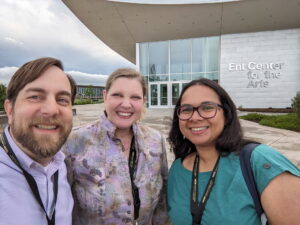
Members of MLA’s Legislation Committee presented at the 12th Annual Kraemer Copyright Conference at the University of Colorado – Colorado Springs Ent Center in June 2025. Committee co-chair Peter Shirts, member Marliese Thomas, and Copyright Website Editor Treshani Perera presented “A Copyright Superpower for Libraries and Archives: Section 108(h) and Music” to an audience of copyright librarians and enthusiasts. MLA provided partial financial support for their participation at this renowned copyright conference.
The presentation explored Section 108(h) of the U.S. Copyright Act, which allows libraries and archives to reproduce, distribute, and share copyrighted works in the final twenty years of their term for preservation, research, or scholarship if the works are not commercially available. Added through the 1998 Sonny Bono Copyright Term Extension Act and expanded by the 2018 Music Modernization Act to cover pre-1972 sound recordings, 108(h) helps preserve fragile or obscure materials such as early recordings and sheet music. The presenters illustrated its application with real-world examples, from digitizing silent film scores to making oral histories accessible, encouraging libraries to embrace 108(h) despite legal uncertainty or risk aversion.
The conference theme “Copyright and the Future of Libraries” focused on how libraries can recover and thrive despite restrictive copyright rulings and rising barriers to access. Centered on advocacy, collaboration, and innovation, sessions highlighted strategies and partnerships that support equitable public access to information.
In her keynote, Chris Bourg explored how libraries can remain resilient amid political, social, and technological disruption. She highlighted MIT’s commitment to open access and its principled stance against restrictive publisher contracts, saving costs while promoting author rights. Bourg emphasized addressing global challenges like climate change and AI through openness, data rescue, and equitable access. She urged libraries to evolve from physical spaces into dynamic platforms for creating and sharing knowledge. Despite attacks on DEI and academic freedom, she argued that aligned library values enable institutions to adapt and lead transformative change.
Kyle Courtney argued in his keynote that libraries shouldn’t need permission to serve their patrons. As digital licensing replaces ownership, libraries risk losing the ability to lend, preserve, and share materials. Courtney encouraged librarians to assert fair use, advocate for e-materials sold with full rights, and expand open access. He reviewed the evolution of Controlled Digital Lending, clarified myths about fair use under contracts, and highlighted state-level efforts to rebalance power between publishers and libraries. His central message: defend library values and reassert access as a public good.
Across both days, conference sessions explored copyright, access, and information equity in libraries today. Presenters examined the erosion of public information and cultural memory online, historical trends in copyright influence, and persistent barriers to accessibility for people with disabilities. Discussions emphasized the gap between copyright law and digital licensing realities, underscoring the importance of advocacy, collaboration, and accurate understanding of copyright principles. Other sessions addressed tensions in scholarly publishing, federal funding, author rights, and the impact of AI and data licensing on research access. Throughout, presenters shared practical insights, debunked myths, and reflected on how libraries can safeguard open and equitable access in an increasingly commercialized information environment.